

In 2026, strategies like Contests, Giveaways, and Freebies are no longer simple “tricks” used by Social Media Managers, but well-established levers within data- and performance-driven marketing plans. In a landscape where user attention is the most valuable resource, these tactics help brands maintain visibility and accelerate community growth while generating measurable results across the digital marketing funnel.
It’s no coincidence that, according to recent statistics, nearly 93% of marketers use Giveaways on social media, and over 60% of companies rely on them specifically to increase brand exposure and audience engagement.
Similarly, Contests are considered one of the most effective lead generation tools, while the use of Freebies, designed as lead magnets, continues to grow as a first touchpoint in modern funnels, enabling the collection of opt-in data without the need for complex legal requirements.
But why do these tactics really work? Essentially, because they respond to two key needs of the modern consumer:
- The desire for immediate value: Consumers today expect something in return for their time and information. A Freebie or a prize delivers exactly that.
- The search for authenticity and connection: Strategies like Contests and Giveaways, when well designed, encourage direct interaction and generate UGC (user-generated content), which can further increase engagement and trust in the brand.
The result? Campaigns that not only perform well but also build real relationships, improve brand perception, and feed the conversion funnel more efficiently.
Now let’s get to the point. In this article, we’ll cover:
- Definitions of Contests, Giveaways, and Freebies: what are they really?
- Strategic objectives of each category
- When to choose one over the other (practical examples)
- Legal considerations
- Some successful case studies
- Conclusion and operational tips
1. Definitions of Contests, Giveaways, and Freebies: What Are They Really?
Contest
A Contest is a competition where only some participants win prizes, selected according to predefined rules such as skill, creativity, or chance. In Italy, these are classified as prize competitions and are subject to specific regulations (Presidential Decree 430/2001).
Main characteristics:
- Winner(s) are selected according to defined criteria (e.g., random draws, skill, voting);
- A formal set of rules and often legal requirements are necessary.
We know a thing or two about Contests. In 2024, we managed one directly for Basement Café by Lavazza, a long-standing client, with a clear objective of qualified lead generation.
Here you can find the full story of the project:
- https://www.rollingstone.it/food/gente/viva-le-storie-che-nascono-sopra-un-caffe-ma-anche-di-piu/890894/
- https://www.nssmag.com/it/lifestyle/35999/lavazza-basement-cafe
Among the most interesting results was a CPL 50% lower than the brand’s previous lead acquisition activities.
And if you’re wondering, “Is it really that complicated to organize one?” The answer is no. Many brands hesitate because they think a Contest is a long, risky, or unmanageable process. In reality, with the right planning, it’s much more straightforward than it seems.
On average, it takes about 3-4 months, divided into defining the mechanics and prizes, drafting the official rules and handling legal procedures, developing creative assets and the landing page, the promotion phase, winner selection and management, and so on.
If you’re considering launching a Contest as part of your strategy but it feels like unfamiliar territory, don’t hesitate to contact us, we can help you structure it effectively and stress-free.
Giveaway
Giveaway literally means “to give away.” Technically, a Giveaway rewards all participants who meet a minimum condition (e.g., following a page, liking a post, commenting).
Main characteristics:
- Prizes are generally simple (e.g., products, vouchers, free services);
- The main goal is immediate visibility and increased engagement.
Important note: The legal distinction between a Giveaway and a Contest is sometimes unclear. Many initiatives commonly called “Giveaways” are actually Contests (i.e., “prize competition” in legal terms) if the number of prizes is limited or if a draw is involved. For this reason, it’s essential to carefully evaluate each initiative and consult a legal advisor or a professional specialized in prize promotions to ensure the activity is structured correctly and complies with Italian regulations.
Freebie
A Freebie is free content offered to users who perform a specific action (e.g., providing an email address, subscribing to a newsletter, sending a DM). It can be a PDF, a mini-course, a checklist, a template, or other digital materials that provide value to the end user.
Main characteristics:
- Everyone receives the free item after completing the required action;
- It is not a prize competition and normally does not require bureaucratic procedures;
- It is often used as a lead magnet to generate qualified contacts.
2. Strategic Objectives of Each Category
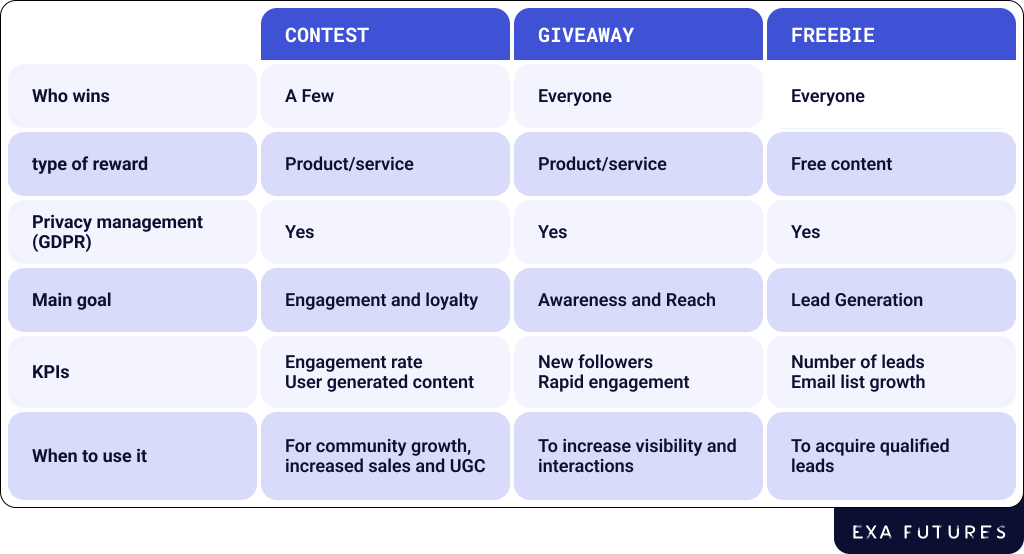
Contest = Qualitative Engagement and UGC
Contests encourage users to create content, participate actively, or interact more deeply with the brand. This can translate into real loyalty and user-generated content (UGC).
Use them if:
- You want to increase qualitative engagement;
- Your goal is to create authentic content that tells your brand story.
Remember: the Contest must be aligned with the brand’s theme and values, otherwise the opportunity may be wasted.
Giveaway = Visibility and Fast Growth
Giveaways often require simple actions (e.g., following a page, tagging friends), leading to rapid growth in social media numbers and strong instant engagement.
Use them if:
- You want high social visibility in a short time;
- You’re launching a new product and want people talking about you.
Be careful: Giveaways with overly complex or unclear rules can reduce participant trust and compromise campaign effectiveness
Freebie = Lead Magnet That Converts
Freebies are ideal if you want high-quality growth of your contact list. They provide immediate value and attract users genuinely interested in your niche or offer.
Use them if:
- You need qualified leads;
- You want to nurture lead loyalty through email marketing.
3. When Should You Choose One Over the Other? (Practical Examples)
Scenario 1: You want to grow your newsletter contact list quickly
Best choice: Freebie. Offer a mini eBook or exclusive template in exchange for newsletter sign-up.
Why? This asset attracts qualified leads interested in your content, not just prizes.
Scenario 2: You’re launching a new product on Instagram
Best choice: Giveaway. Offer the new product to users who follow your profile, tag friends, and share a story.
Why? You increase brand visibility, social reach, and attract new followers.
Scenario 3: You want to increase sales of one of your products
Best choice: Contest. Reserved for customers who purchase the product (verified via receipt upload).
Why? It incentivizes immediate purchases and increases perceived product value.
4. Legal Considerations
Even though Contests, Giveaways, and Freebies are widely used on social media, you can’t just do anything online. Every initiative must comply with the law, or you risk significant fines. In Italy, the main rules are set out in Presidential Decree 430/2001 and official guidelines from the Ministry of Enterprises and Made in Italy.
Contest
Requirements:
Contests almost always fall under prize competition regulations and must comply with Italian law.
- Clear written rules, including participation methods and winner selection criteria (Presidential Decree 430/2001, Art. 11);
- Prior communication to the Ministry of Enterprises and Made in Italy;
- A third-party official to ensure transparency (notary, Chamber of Commerce officer, or certified digital system);
- Transparency about prizes and awarding timelines.
Allowed on social media:
- Commenting, posting content, or sending private messages to participate;
- Using likes or reactions as a voting method;
Managing the contest via apps or external platforms.
Not allowed (on social media):
- Forcing users to share posts or tag people to participate (source);
- Using only social buttons as a mandatory participation condition.
Giveaway
In the past, Giveaways were surrounded by legal uncertainty, as they were not clearly classified as prize competitions. This changed in 2017, when the Ministry of Economic Development equated Giveaways with official prize competitions, making compliance with existing regulations mandatory.
So who can organize them? Companies and organizations. Only legal entities (companies, brands, associations) are authorized to run these competitions. They must follow the process required by Presidential Decree 430/2001, including official communication to the Ministry and supervision by a notary or Chamber of Commerce official for winner selection.
Private individuals are not allowed to organize Giveaways as natural persons. Doing so is considered illegal unless the prize has purely symbolic value (like a pencil).
Freebie
Freebies are not prize competitions because everyone receives the gift, so they are not subject to the same legal obligations.
What’s required:
- Transparency about the free item and how to access it;
- Clear GDPR information and explicit consent if personal data is collected;
- Consistency between what is promised and what is delivered.
What’s not required:
- Notary or third-party official;
- Communication to the Ministry.
5. Successful Case Studies
- Contest Example – Starbucks, White Cup Contest
A classic UGC Contest: Starbucks invited customers to decorate its white cups, post photos on social media with a dedicated hashtag, and win the chance to see their design turned into a limited-edition reusable cup. The contest generated around 4,000 pieces of content in three weeks and strong global engagement. - Giveaway Example – Domino’s Pizza, #PieceofthePieContest
Domino’s launched an Instagram Giveaway with a $10,000 cash prize for a superfan, asking users to post a creative photo with a dedicated hashtag. The campaign performed well because participation was simple, the prize was concrete and desirable, and it generated high engagement (nearly 1,000 submissions), social visibility, and involvement from both loyal fans and new users. - Freebie Example – HubSpot, Free Marketing Templates
HubSpot created a library of free templates, such as marketing plans, editorial calendars, and email templates, available for download in exchange for users’ contact details. This type of Freebie has become a core part of their lead generation strategy, significantly growing their email list and engagement because users find immediate, practical value they can reuse in their daily workflows.
Conclusion and Operational Tips
Contests, Giveaways, and Freebies only become truly effective when they are part of a clear, measurable strategy aligned with business goals. The real mistake is using them without a precise direction.
Let’s do a quick recap:
Freebies work best when the focus is on contact quality and building a sustainable funnel over time. Offering value before asking for something in return remains one of the strongest levers in digital marketing, especially in B2B or highly competitive contexts. A well-designed Freebie doesn’t just collect emails, it positions the brand as authoritative and relevant.
Giveaways are powerful tools for generating visibility and accelerating growth, but they must be handled carefully. If they’re not connected to a clear message or follow-up goal, they risk attracting an audience with little interest in the brand. When integrated into a broader strategy, however, they can be an excellent entry point for new users and an accelerator of organic reach.
Contests, finally, are probably the most strategically underrated format. When properly designed, they combine engagement, user-generated content, and even direct sales, turning participation into a high-value action for the brand. They are especially effective when the goal is to build a deeper, longer-lasting relationship with the community.
In today’s digital marketing landscape, there are extremely powerful tools, if used correctly. Contests, Giveaways, and Freebies are three different levers, with different goals, that can coexist within the same strategy when guided by data and a clear vision.
For brands and companies that want to grow sustainably, the real challenge is designing these strategies effectively, integrating them into funnels, measuring their real impact, and optimizing them over time. That’s where strategy makes the difference compared to simple execution.

Leave a Reply