

2026 promises to be a year of significant developments in the field of Artificial Intelligence and technological innovation in general. We will see profound changes in the way people interact with their surroundings, both digital and physical, and in the way companies connect with their customers.
In our previous article, we explored general trends and strategic priorities to focus on in the new year. Today, we shift our focus to the retail sector and analyze the trends that will shape 2026 for companies that manage e-commerce or a network of physical stores.
In this article, we propose eight trends for 2026 that e-commerce and retail companies should pay attention to:
1) The Era of “AI Agents”
2) In-Store Mobile
3) Experiential Retail and “Phygital” Convergence
4) Alternative Revenue Streams
5) Private Labels as a Value Choice
6) Tiktok and the Evolution of “Social Commerce”
7) Loyalty & Rewarding Programs
8) Circular Economy (Recommerce)
9) Conclusions
1) What Is the New Era of “AI Agents”?
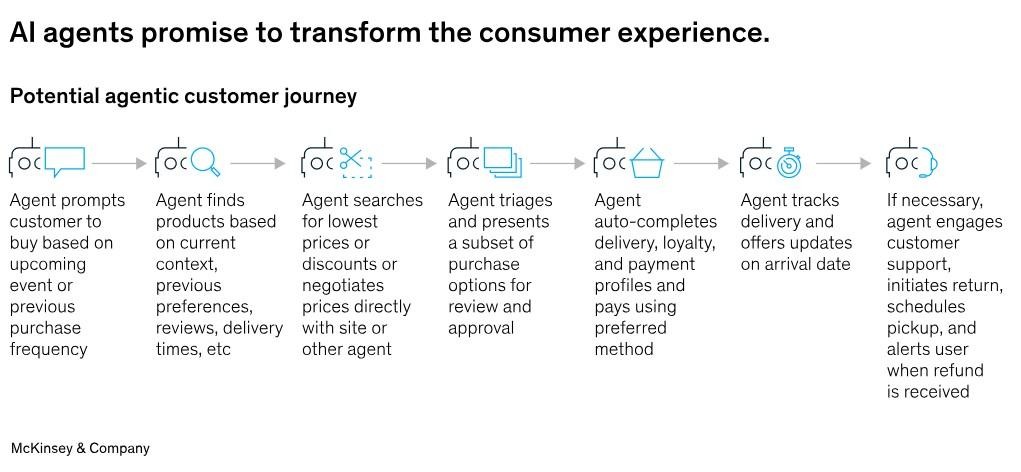
This trend is confirmed by the latest edition of Salesforce’s Connected Shoppers report. The study, which involved 8,350 customers and 1,700 decision-makers, shows that 34% of retailers already use AI agents in their processes. Current uses range from customer service (e.g., automated support for tracking and returns requests) to e-commerce optimization and complex supply chain and inventory management.
However, while AI currently works “behind the scenes” for companies, the next big evolutionary leap will see it take center stage for consumers. By 2026, advanced tools such as ChatGPT’s recent “agent mode” will not only provide information, but will become true virtual assistants capable of interacting autonomously with third-party services. They will browse websites and e-commerce sites, compare products and offers in real time, and ultimately make purchases on behalf of the user. The real added value? Giving people back their most precious and scarce resource: time.
It is estimated that by 2030, this market could generate up to $1 trillion in the US B2C retail sector alone, with global projections ranging from $3 trillion to $5 trillion (source: McKinsey).
Companies will need to redesign their digital ecosystem to accommodate a new type of customer: the AI agent. This means shifting the focus from emotional and visual persuasion (typical of the human experience and traditional marketing) to logical and structural data transparency, making their products and services easily “readable” and purchasable by AI agents, through dedicated APIs and new security protocols.
2) How Is In-Store Mobile Transforming the Shopping Experience?
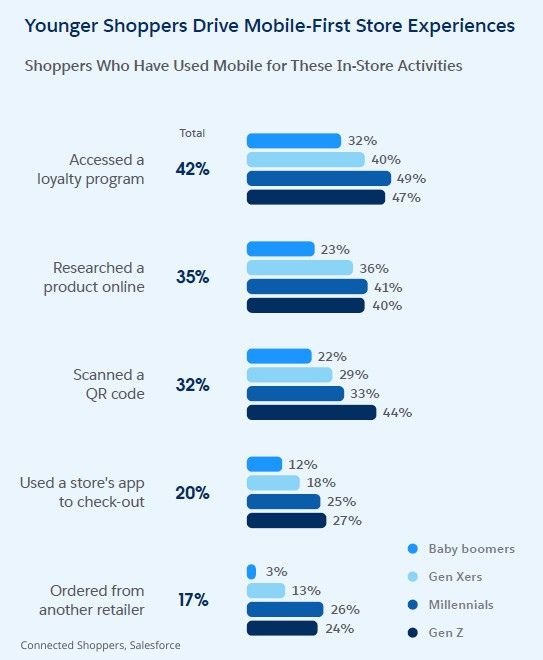
In 2026, customers will increasingly use their cell phones while physically in stores. This trend is driven by Gen Z, who are twice as likely as Baby Boomers to use a store app to checkout, avoiding the queue, and eight times more likely to place an order with a competing retailer while still in your store (source: Connected Shoppers by Salesforce).
The winning strategy for transforming the customer’s smartphone from a “distraction” to a “conversion tool“? Adopt solutions that add immediate value to the physical shopping experience, such as the intelligent use of QR codes or NFC tags to unlock exclusive content (e.g., in-depth reviews and tutorials, access to product variants not on display, or exclusive discounts).
3) How Are Experiential Retail and “Phygital” Models Converging?
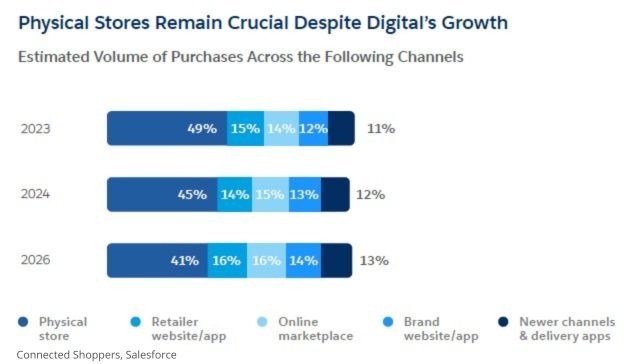
Global estimates indicate that purchases made in physical stores will decline from 45% in 2024 to 41% in 2026 (source: Connected Shoppers by Salesforce). However, interpreting these numbers as a simple decline would be a strategic miscalculation. We are not facing the end of the physical store, but its metamorphosis.
The point of sale is evolving and will become a crucial hub of the “phygital” (physical + digital) shopping experience, while the barriers between it and e-commerce are set to disappear for good, giving way to a smooth and frictionless customer journey.
This trend is already well established in consumer habits (today, as many as 52% of users say they buy products online and use their local store as a pick-up point) and will become increasingly central in 2026.
In this new scenario, stores no longer serve only to “sell,” but become a strategic asset for logistics, brand experience, and direct customer relations, unifying paths that once ran on parallel tracks.
4) What Are the New Alternative Revenue Streams Emerging in Retail?
In a market environment where price competition is constantly eroding profits, retailers will explore new revenue streams beyond traditional retail in 2026 to improve margins.
Among these, Retail Media Networks represent one of the fastest-growing opportunities, with advertising spending set to exceed $165 billion globally by 2025, according to research by Deloitte. Successful international examples include Amazon, which generated $47 billion from this segment in 2023, and Walmart, which recorded 28% growth to $3.4 billion.
How can this trend be capitalized on? By leveraging the assets that retailers already have: for example, transforming website traffic, mobile apps, vast customer data assets, and even in-store digital screens into premium advertising space.
5) Why Are Private Labels Becoming a Strong Value Choice for Consumers?
According to research by Capgemini, 2026 will see a paradigm shift: private label products will no longer be considered a fallback or an economical alternative, but a conscious choice of value. This is demonstrated by the fact that, in the United States, 70% of high-income shoppers now choose their supermarket based on the quality and exclusivity of these products.
For retailers, this is a crucial moment to analyze their customers’ data and preferences, and then use these insights to enrich their assortments with “premium” products to build loyalty.
6) How Are TikTok and “Social Commerce” Evolving Today?
The platform has sparked a cultural revolution that is redefining the way we shop online: for Gen Z, TikTok has become the primary social e r for discovering new products (40% use it for this purpose, according to Salesforce research). The viral phenomenon “TikTok made me buy it” is not just a hashtag with billions of views, but tangible evidence of a new, more impulsive purchasing behavior driven by social validation.
In 2026, with the growing popularity of TikTok Shop, the line between entertainment and shopping will disappear: people will watch a video, trust the creator, and buy with a click, without ever leaving the platform.
For retailers, this means that social media strategy can no longer be limited to brand awareness: it must evolve into a direct sales strategy capable of converting attention into revenue.
7) How Do Loyalty and Reward Programs Influence Customer Behavior?
Customer loyalty has become an extremely fragile concept: three out of four shoppers have switched brands in the last year, according to a Salesforce study. Although price remains the main cause of this “betrayal,” over 40% of consumers cite poor customer experience or product quality as a deciding factor. This phenomenon of brand hopping is widespread, but it is particularly pronounced among the younger generations: Gen Z and Millennials switch brands at a rate 1.3 times higher than Baby Boomers.
Faced with this volatility, retailers are rushing to increase their investment in loyalty programs. Currently, 67% of retailers offer a loyalty program, and an additional 29% plan to launch one in 2026, such as the classic “points collection” or cash-back for the more savings-conscious.
But the real strategic value of these programs, in addition to increasing Customer Lifetime Value, lies in an often underestimated financial lever: the ability to increase profitability. A well-structured rewards program allows the brand to offer a reward that the customer perceives as being of very high value, but which costs the company only a fraction of its market price.
8) How Is the Circular Economy (Recommerce) Reshaping Retail?
The circular economy has ceased to be a simple item in the sustainability balance sheet and has become a revenue channel. In 2026, we will see growth in “recommerce,” a model in which retailers do not just sell new products, but actively manage the product life cycle through trade-in, buyback, and upcycling programs.
And this is not a passing fad: according to Deloitte, in the United States alone, this market is projected to reach $276 billion by 2028.
While this trend was initially almost exclusively limited to the luxury sector (where vintage items maintain or increase their value over time), today it has become more widespread, rapidly expanding to the mass market. The example of IKEA, which has integrated services for the repurchase, repair, and sale of used products (such as the “Circularity Corner“), demonstrates how major players are rethinking their value chain.
For companies, the advantage is twofold: on the one hand, they are tapping into a consumer base that is increasingly concerned about environmental impact, and on the other, they are opening up new revenue streams on goods already produced, increasing customer contact frequency and brand loyalty.
9) What Conclusions Can We Draw About the Future of Retail and AI?
These eight trends send important signals that retail is not in crisis, but evolving. The difference between companies that will suffer from market changes and those that will dominate it lies in their ability to understand how consumer behavior is changing and how to integrate technology to meet their needs.
Is your company ready for “AI agents” and “phygital” convergence? At Exa Futures, we help companies decode the signs of the future and turn them into competitive advantages.
👉 Contact us for strategic advice.

Leave a Reply