


It is fascinating to see how the vision we outlined for 2026 is taking shape in such a concrete way. We predicted that this would be a year of significant developments for Artificial Intelligence and that advertising platforms would become so sophisticated that they would anticipate consumers’ needs even before they were expressed through a search or conscious action.
Today, Meta’s new predictive systems confirm this direction, revolutionising the way ads are displayed, ranked and optimised. We are no longer in the era of simple interest-based targeting: the platform is now capable of reading so-called ‘weak signals’, such as time spent on non-commercial social content or interaction in a community, to anticipate the user’s deeper intentions.
For those who manage e-commerce, this means moving to a proactive rather than reactive marketing approach. Advertising campaigns do not simply chase a target, but select the most relevant ad for each potential customer based on their future needs. The result? Smarter, more predictive and contextual advertising, which should translate into a better ROAS.
At the heart of this revolution is Meta Andromeda. Although it is the name that has captured the collective attention, Andromeda is only part of a much more complex new technological infrastructure, which also includes Meta GEM, Meta Lattice and Sequence Learning.
At Exa Futures, we have therefore decided to study this innovation in more detail for you, to understand what sets it apart from previous solutions, how we can support you in making the most of it, and how it could concretely help your business. As with any announcement from the big players in digital marketing, we want to ensure that Andromeda is not just a superficial change, but a tool capable of bringing concrete benefits to your objectives.
To this end, in this article we will explore how these systems work and how brands can adapt to a phase in which AI decides what to show, to whom and when. We will do this by attempting to answer some of the most frequently asked questions from advertisers and e-commerce managers:
1. What is Meta Andromeda: the ‘Ads Retrieval’ System
2. How Does Meta Andromeda Work for Advertising?
3. What is Sequence Learning?
4. What do Meta Andromeda’s Predictive Capabilities and Multiple Selling Proposition Have to Do with It?
5. What Does This Mean in Practical Terms for E-commerce and Advertisers?
6. Conclusions and Strategic Recommendations
1. What is Meta Andromeda: the ‘Ads Retrieval’ System
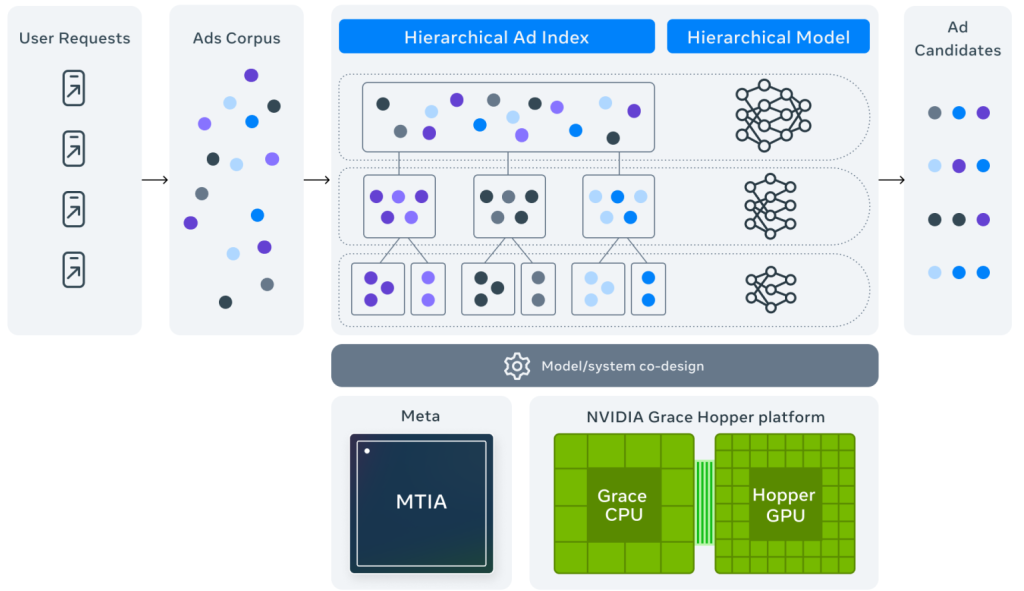
Often confused with a simple algorithm update, Meta Andromeda is actually a powerful “Ads Retrieval” system, i.e. an ultra-fast filter that, in a few milliseconds, scans millions of ads to select only the few thousand that are truly relevant to a user, discarding the superfluous ones before the actual auction even begins.
This is possible thanks to an architecture that analyses not only clicks or ‘likes’, but also trillions of ‘weak signals‘, i.e. more or less conscious user behaviour (e.g. micro-movements, content consumption sequences and cross-platform interactions) to build a probabilistic model of their future needs.
In addition to Andromeda, this infrastructure includes:
- Meta GEM (Generative AI Model) interprets the user’s deep context, ensuring that investment is focused only on those who are in a real ‘purchase window’.
- Meta Lattice unifies data from every source (e.g. Reels, posts, but also data from your e-commerce).
This is how it understands that a user will need a sofa, not because they searched for “sofas”, but because they watched three Reels on how to “furnish a two-room flat” and visited a property listing site.
All this is possible thanks to computing power 10,000 times greater than that of the previous infrastructure: to ensure such fast and smooth operation, Andromeda combines advanced proprietary software architecture, Meta Training and Inference Accelerator (MTIA), with next-generation hardware, NVIDIA Grace Hopper Superchip.
2. How Does Meta Andromeda Work for Advertising?
Andromeda’s operation is based on a new hierarchical classification logic. Instead of analysing ads in a linear and slow manner, it organises them into ‘smart maps’ and transforms users and products into compatible mathematical profiles. This allows the system to instantly calculate the ‘distance’ between what the brand can offer and what the user wants (Similarity Score).
This approach allows the enormous volume of creativity generated by AI (as in Advantage+ campaigns) to be managed at unprecedented speed. According to Meta Engineering data, the new system has achieved a +6% improvement in ad recall (the ability to identify relevant ads) and an +8% improvement in perceived ad quality.
3. What is Sequence Learning?
Another key pillar of Meta’s new advertising system is Sequence Learning, which is the AI’s ability to understand the user’s ‘story’ over time. If Andromeda decides what to show, this system decides when.
By analysing the user’s history over time and the sequence of events – for example, booking a flight followed by watching videos of snow-capped mountains – the algorithm predicts that the next logical step will be renting ski equipment or booking a hotel. Targeting is no longer set manually by the advertiser, but rather the creative itself intercepts the right user at the perfect moment in their purchasing journey.
4. What do Meta Andromeda’s Predictive Capabilities and Multiple Selling Proposition Have to Do with It?
Andromeda’s predictive capabilities evolve the concept of Unique Selling Proposition (USP) into Multiple Selling Proposition (MSP).
Unfortunately, experience in the field shows us that, often due to budget constraints or a vision still tied to old ‘traditional’ advertising models, many brands tend to communicate a single message to their entire audience.
Andromeda breaks this pattern: it understands which psychological lever will move a specific potential customer at a given moment. To some, it will show an advert focused on savings, to others one focused on status or convenience, while promoting the exact same product.
5. What Does This Mean in Practical Terms for E-commerce and Advertisers?
In recent months, many advertisers have noticed unstable performance, observing creatives that seem to age in a matter of days and historical audiences that suddenly stop generating results.
Meta seems to be suggesting that targeting is no longer the driving force behind campaigns, but has become just one of the useful signals for the algorithm. In this new architecture, creativity is the real language with which it is possible to communicate with the algorithm, while tracking represents the vital context that allows it to interpret whether what we are offering is truly relevant to the end user.
Consequently, Meta seems to suggest that insisting on hyper-segmentation or ‘forcing’ the delivery of certain ads no longer makes campaigns more effective; on the contrary, it risks paralysing the learning processes of a system designed to evolve in real time.
The marketer’s strategic control over campaign settings has not disappeared, it has simply evolved: Meta wants to encourage the use of broad audiences and AI-based automation, giving the algorithm greater freedom to efficiently select relevant ads for each user.
6. Conclusions and Strategic Recommendations
For CMOs, e-commerce managers and marketers, the strategic roadmap for approaching and benefiting from Meta Andromeda is clear:
- it is essential to correctly track and integrate data from multiple sources, including first-party data;
- a wide variety of truly differentiated creative content must be provided to allow the system to test different messages (MSP).
Finally, the golden rule for 2026 is ‘strategic patience’: despite its computing power, AI needs volume and stability to learn the user’s context, so it is advisable to avoid constant changes and fragmenting budgets across too many campaigns.
Meta’s promise is to deliver superior performance and unprecedented efficiency. Our goal at Exa Futures is to continue to thoroughly test Andromeda to see if this new infrastructure lives up to expectations and if its predictive capabilities translate into real and consistent acquisition cost (COA) reductions and ROAS increases.
Is your company ready for this new advertising paradigm? At Exa Futures, we help businesses decode the signs of the future and turn them into competitive advantages.


Leave a Reply