


If you are wondering how the words “weather” and “marketing” end up in the same sentence, this article is for you.
We’re all aware that the weather influences a large part of our decisions: from the clothes we wear, to what we eat, to the choice of holiday destinations; but above all, it influences our mood. Just think about how on a sunny day, you will be more likely to walk than take the car, just as in winter you will probably choose hot meals over a salad.
This is how weather marketing was born, a form of automated marketing that uses real-time meteorological data to tailor advertising messages according to local conditions.
THE INFLUENCE OF WEATHER
WeatherAds, a weather marketing platform, estimates that the weather can influence the sales of around 30% of goods and services, while the British Retail Consortium claims it’s one of the most influential factors in consumer behavior.
Also, WeatherAds tells us that, more specifically, weather influences consumers on 3 different levels:
- Their purchase method
This is the easiest level to link to the weather: a study found that, in terms of online shopping, the difference between sunny and cloudy days is 10-12% in sales of clothing, home furniture and wholesale products. And, if you are assuming that it’s the sunny days that produce this increase in purchases, it is quite the opposite. On bad days, traffic to e-commerce tends to be higher than on good days, during which people tend to visit the physical stores more. - Their mood
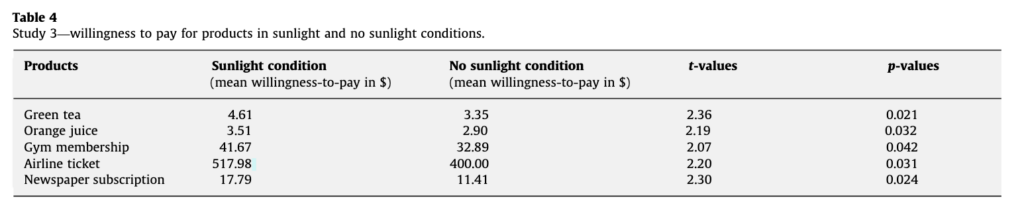
The second level might be just as obvious (or maybe just to me, as a good meteropathic). Professor. Kyle B. Murray, Professor of Marketing and Director of the School of Retailing at the Alberta School of Business, demonstrated in his study “The Effect of Weather on Consumer Spending” how exposure to sunlight can lead to a crazy increase in consumer purchasing willingness. He showed, for example, how on sunny days people are willing to pay 56% more for a newspaper subscription or 37% more for green tea.
- Their product choice
Finally, the type of products we choose to buy. In addition to classic consumer goods such as clothes, food, and medicine, there are also plenty of other sectors affected by the weather conditions. According to WeatherTrends360, every 1-degree hotter leads to a +5% increase in sales of lawn mowers, just as every 1-degree colder brings to a +6% increase in sales of mousetraps. Even high-value goods such as cars and houses are affected by weather, as demonstrated by a study conducted by the National Bureau of Economic Research.
THE WEATHER MARKETING
It is now well known that a successful marketing campaign can engage the audience through personalized and contextually relevant experiences. Using real-time information, such as weather, will help make the message more meaningful and impactful for the target audience, generating a much higher engagement and conversions potential compared to a classic advertising campaign.
Weather marketing is built on the customization of online advertising messages based on the atmospheric conditions in the area where users are located. Thanks to geolocalization it will then be possible to customize messages on websites, newsletters, ads, and even through SEO (a brand selling clothes could easily optimize the search for sweaters and coats in winter and bikinis and shorts in summer).
But how to build a weather-based marketing campaign? In this case, some platforms come to help us, just like the aforementioned WeatherAds, which allow weather-based automation to be applied to classic display, search, social and shopping campaigns.
For example, a snow removal company could activate search campaigns exclusively in areas where it has just snowed and grab the first search results at the exact moment when users are searching for that specific service. Or, again, a taxi service could activate its advertising only on rainy days, which is when there is the most demand.
CASE HISTORY: PANTENE
Due to the drop in sales in 2013 (-7% compared to the previous year) caused by a lack of innovative products and strong competition from other brands, Pantene decided to experiment with a new method to increase sales without having to introduce new products: thus the “Haircast” campaign was born, in collaboration with The Weather Channel and the Walgreens shop chain.
The target group of the campaign was women between 40 and 45 years old, with a healthy lifestyle, looking for that confidence felt from appreciating their appearance. Hair, which contributes largely to women’s self-perception, is one of the most difficult aspects to control, precisely because of weather conditions: humidity, rain and strong sunshine are external factors that can influence its condition. In particular, it’s the days with high humidity – which give birth to the famous ‘bad hair days’ – that push women to look for new products that can salvage the frizz.
Obviously, Pantene could not change the weather, but it could offer a solution to those consumers who were looking for one at that very moment: a “Haircast” was offered every time consumers checked the weather on their smartphones, along with a suggestion of the most suitable product for those specific conditions, a discount coupon and directions to the nearest Walgreens shop, so that they could have beautiful hair ‘whatever the weather’.
The results of the campaign were excellent:
- +24% sales of Pantene products at Walgreens in July and August compared to the previous year
- An average of 370,655 organic monthly impressions for the hashtag “#haircast” on Twitter
- 37.5% higher than goal for an incremental merchandising in 5,500 Walgreens shops thanks to a display placed in the main shop aisle
- +4% more sales in the entire hair products category in Walgreens shops
In short, you now have no more excuses to accuse your meteoropathic colleague of exaggeration ☀️
Curious to find out more news about the world of social media and digital marketing and always want to be on the ball? Sign up for our newsletter to be updated on all the latest news 📫


Leave a Reply