

Used by over 5 billion people (according to the Statista website dated April 2024) all over the world, social media are among marketers’ favorite platforms for communicating brands, primarily through advertising campaigns pointing to precise call to actions (conversions, click on links, profile views, etc), which allow an accurate tracking of users’ actions, as well as the measuring of the goals achieved.
Article published on 26 November 2020 and updated on 21 June 2024, in particular regarding the number of social media users worldwide.
However, according to a research by Demand Metric, 70% of people prefer to collect information about a brand through other channels: be it articles, posts, images or videos, good content proves to be of vital importance to attract new potential purchasers (source: https://www.convinceandconvert.com/content-marketing/content-marketing-statistics/).
That is why social media organic strategy, if well designed and planned, is a fruitful and successful resource.
In this article we will go through the following topics:
- What is Content Marketing
- Personas, Values and Tone of Voice
- Content Creation and Social Media Platforms
- Benefits for Your Business

Content Marketing
Content marketing is a strategic marketing approach focused on valuable content (“Content is king”, to quote Bill Gates), aiming to attract and retain the audience in a profitable way. Two are the key aspects of content marketing: content and strategy.
As far as content is concerned, it must prove valuable in three main areas:
- Information: it must offer one or more useful concepts or news to the user;
- Entertainment: content must be interesting to the user;
- Education: content developed with the user in mind, and which holds as honest and transparent as possible.
We all know that the era of imperatives is over, and that today’s marketing turns towards the so called persuasive marketing, which leverages on subtler elements in order to communicate with potential purchasers.
And such marketing strategy is even more polished when it comes to social media which, as you already know, encourages real conversations with the audience. A type of conversation users have at heart: 80% of potential purchasers, in fact, claim that the interaction with a brand is as important as its products or services (source: https://www.salesforce.com/blog/marketing-statistics-to-know/).
As we told you in our Real Time Marketing blogpost, a profitable interaction with the community is fundamental to establish loyalty and increase brand awareness.
Content marketing proves to be over 3 times more effective than outbound marketing (source: https://review42.com/content-marketing-statistics/), but to get the results we wish for, it is necessary for the content creation on social media not to be left to chance, but rather analyzed in a preliminary study, in order to plan a successful strategy.
Personas, Values and Tone of Voice
First thing to do is identifying your personas, that is an image of your purchasers or, in this case, of your followers.
To do so, the inner tools available on different platforms are of great help. The insights available on social media allow a general representation of the users your audience is made up of: age, gender and geographical position are just some of the metrics to be considered.
Furthermore, if you are looking for a more detailed portrayal, MarTech can help you out with AI-based tools that automatically build personas. Such as Social Bakers (https://www.socialbakers.com/), which organizes the audience’s interests, affinities and motivations to create the most accurate personas.
Once the audience has been identified, it is important to establish the key values around which to build our social communication. That means the features which better represent the brand image you wish to convey and, also, which are common ground with your community.
The tone of voice is also fundamental to build the brand image, i.e. the tone to use while communicating, both verbally and visually.
In this regard, it is also important to remember that the tone of voice has shall adapt also to the platform used: informality, for example, is a good choice on Instagram, while LinkedIn requires a more professional register.
Another element which should not be underestimated is the coherence between the words and the tone of voice used on social media, with the ones used on the official website: choosing the proper keywords for your site is a consistent practice, and same should be done while creating content for social media.
Even in this case, a sensible use of SEO techniques can lead to a better ranking both on social media and on search engines.
A 2019 research by Optinmonster, in fact, shows a good reputation on social media, as well as proper linking, to be of great help for increasing ranking on search engines. Google was never clear on the matter, butt it claimed that social media platforms are treated as any other webpage and, as such, scanned in search for results (source: https://neilpatel.com/blog/social-media-and-seo/).

Content Creation and Social Media Platforms
It is now time to create the actual content. As we said, it is necessary for it to undergo the aforementioned features, (i.e., information, entertainment and politeness), but always keeping in mind our audience and the interest that may arise from the posted content.
While choosing which type of content is the most suitable, don’t forget that visual content has a more immediate impact on people. In 2020, video content seems to be the most successful: 84% of users claimed to have been persuaded to purchase a product or service by watching a video online and, on the other hand, also 93% of brands claim to have gained at least a new client thanks to video marketing on social media (source: https://www.hubspot.com/marketing-statistics).
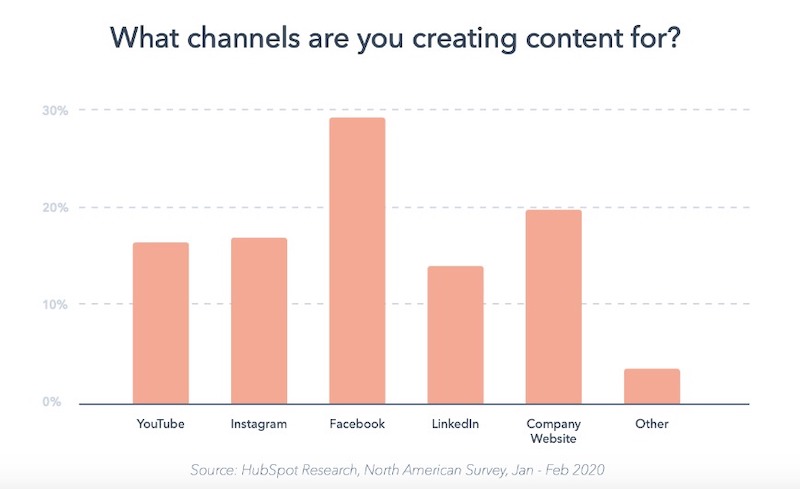
Facebook and YouTube (respectively with 79% and 85%) are definitely the favorite platforms for sharing video content, which places second among the types of content used to engage the audience, followed by live videos (source: https://www.hubspot.com/marketing-statistics).
But if you are addressing to an audience made up of millennials, Instagram still proves to be the most suitable channel: 2/3 of users is under 34 years old and, according to marketers, the platform places second for generated ROI (source: https://www.hubspot.com/marketing-statistics).
On the contrary, if you are turning to professionals, LinkedIn is obviously the right platform for your needs. It is, after Facebook, the most effective at B2B marketing and as effective as Facebook at video marketing: over 87% of marketers, in fact, claimed to have achieved great results using this channel (source: https://www.hubspot.com/marketing-statistics).
Case Study: “Ricola e il Meraviglioso Mondo delle Piante” (Ricola and Plants’ Wonderland)
An illustrative content-driven video campaign (which Exa Futures managed according to these guidelines) is the one created by Ricola earlier this year, called “Giovanni e il Meraviglioso Mondo delle Piante” (“Giovanni and Plants’ Wonderland”).
Thanks to Ricola strategic vision and the production company Blue Joint Film, the campaign was designed to have great educational and entertaining impact on the target. The project involved Giovanni Storti (a famous Italian comedian, part of the comic trio Aldo Giovanni e Giacomo) and the vegetal neurobiologist Stefano Mancuso, both protagonists in a series of short videos, which were meant to be distributed online, both on Facebook and YouTube.
The high-quality content, along with a precise planning and an accurate targeting, led to exceptional results, with great appreciation from the audience. In only 8 weeks, the videos had been seen over 6,5 million times, and almost 1 million times in their full length, for a grand total of over 86 thousand hours of “view time”. On top of this, as to engagement, goals were fully achieved with over 36.000 direct interactions – likes, comments and shares – by the engaged users.
If you are curious, here are all the videos created and distributed for the project (in Italian language): https://www.ricola.com/it-it/scoprire/il-mondo-delle-piante

Benefits for your Business
We already said and pointed it out: “Content is king”. But what are the real benefits a content marketing strategy on social media can grant?
- Helping building a solid brand image: 78% of users would rather get in touch with a brand through non-advertising channels (source: https://www.lyfemarketing.com/blog/why-is-content-marketing-important/). That is why a brand offering valuable content to its community is perceived as more reliable.
- Increasing of retention and audience loyalty: 70% of users claim that businesses using content marketing show a genuine interest in building a real relationship with the customer (source: https://www.lyfemarketing.com/blog/why-is-content-marketing-important/). If advertising campaigns produce great results when it comes to attracting new users, content marketing is the most effective organic strategy for retention.
- Generating new leads and increasing traffic: content marketing can increase up to 3 times generated leads compared with traditional advertising strategies, as well as increase their quality (source: https://assetdigitalcom.com/content-marketing-important/). Good content, in fact, makes it more spontaneous to click on the call to action, while driving the user to the official website.
- Improving conversions: considering that 68% of users enjoy spending time online searching for content about their favorite brands, conversion rate can increase up to 6 times thanks to content marketing. According to 72% of marketers, video content can generate a particularly good ROI in this perspective (source: https://www.lyfemarketing.com/blog/why-is-content-marketing-important/)
- Reducing costs: costs decrease down to 62% compared with traditional marketing strategies, while investing a relatively low amount of time; 81% of marketers claim to have had an increase in traffic with only 6 hours per week spent creating valuable content on social media (source: https://www.lyfemarketing.com/blog/why-is-content-marketing-important/).
If you are thinking about planning a content marketing strategy on social media, or if this article simply piqued your curiosity, please contact us: we are always happy to chat about digital marketing. And if you’d like more content, subscribe to our newsletter by clicking here.