


A topic as extended as SEO would certainly require much more time and space than a single article: but let’s try to make some order and explain it best!
In this article we will deal with one of the main activities that we carry out in Exa Futures and we will make the following topics clearer, referring, for the time being, to classical SEO.
In fact, there are different types of SEO: classical, local, mobile stores and even e-commerce related.
- What is SEO?
- Why is it so important?
- Google, between algorithms and updates
- How are the results analyzed by Google?
- On-Page and Off-Page Optimization
- Technical aspects of SEO, contents, internal and external links
- SEO and Social Media
- SEO timeline
The acronym S.E.O. literally translates as “search engine optimization“.
This term refers to all those activities aimed at improving the scanning, indexing and positioning of information or content on a website by search engine crawlers (softwares that analyze content in a methodical and automated way), in order to improve the positioning in SERPs (search engine result pages).
SEO: WHAT IS IT?
So, what exactly is SEO?
Put simply, it is the art (and science) of persuading and convincing search engines to recommend your content to their users as the best solution to their problem.
If this is your goal (and if you’re reading this article, we believe it is!), three things need to be done:
- Be sure that search engines know who you are and what you offer;
- Convince search engines that your content is the most credible and reliable option;
- Make your content useful and able to meet users’ requests.
SEO: why is it so important?
Search engine optimization brings the most valuable traffic (the organic one) to your website, as well as “free” traffic: when a user clicks on the result of your content, you do not pay Google (or other search engines) for the visit, but you achieve your goal without cost. On the other hand, paid results (identified by the icon “Ad” on the left) require the advertiser to pay the search engine for user clicks and visits on your web site.
So, to sum up: the bright side of SEO traffic is that, if the Search Engine Optimization strategy chosen is effective (we’ll talk about it later), it is, as a matter-of-fact, a continuous source of free traffic.
Search Query: what is your audience looking for?
The main goal of search engines is to satisfy their users and provide them with the best results in relation to the demand or request made. For this reason your content should be the most useful and relevant to the searches of potential users.
Once you are sure that your content is optimized in terms of view of content, you should ask yourself: how can I make the user find it? With “keywords” or, technically, “search queries”: not single words, but a combination of words that express a problem or ask a question.
To start doing a good job in SEO, one of the first things to do is to understand what your potential customers (or users) are looking for and what words they use to express this search.
The next step is to find the phrases that users use more often (the “search queries”) and then create contents that bring a clear, simple and useful solution to their problem and that contain all the words that the user has searched for on search engines.
Google vs other search engines: an absolute supremacy
Google dominates the search in most countries of the world, to the point that we could almost call it a monopoly. Its percentages vary between 86% and 87% of global searches, while other search engines (Bing, Yahoo, Baidu, etc.) share the remaining ones (source: https://www.statista.com/statistics/216573/worldwide-market-share-of-search-engines/).
These numbers make Google the preferred search engine for users and, as a consequence, the main one to focus on, while creating a SEO strategy.
The three parameters that Google uses in suggesting the most relevant answer (from the most reliable source and in the most appropriate format) for its user, are:
- Relevance – The match of the best answer to the question Google has understood;
- Trust – The submission of content from a secure source, which will satisfy its user;
- Usability – The submission of content that can be used in the best format.
The user’s intent and the most accurate content are, basically, the matches that Google wants to satisfy.
When someone is looking for something, it actually expresses a problem to which it has to find a solution (whether it is an action to be taken, a product to be purchased or a place to be found, is of little importance).
Often, however, the expression of that problem occurs in an incomplete or ambiguous way.
And that’s when Google plays an important role , trying to figure out what exactly users mean – i.e. what their intent is; what specific problem they are trying to solve.
So the question is: what is the most useful, accurate and reliable content to satisfy the user and its intent?
This question is answered by SEO, which becomes the means to show your content to Google and convince it that your content is the most useful, reliable and accurate for the user.
Did you miss our blogpost on MarTech?
Click here to read it
Google, between algorithms and updates
Google’s algorithm is something that many people are afraid of. But don’t worry, it doesn’t bite!
For those who deal with SEO, the main goal is to send signals to this algorithm to convince it that the answer (i.e. your content) is the best, the most useful and the most appropriate for the question it has understood (i.e. the one the user has asked).
It is good to know that Google constantly updates its algorithm. But don’t worry, because most of the updates are minimal and will not lead to drastic changes.
It happens, however, that from time to time Google implements important updates that can affect the positioning and traffic on your site quite significantly. So watch out, you have to keep them under control!
In order not to miss any news, please notice that Google announces most of the most important updates on Twitter (check them here: https://twitter.com/searchliaison).
How are the results analyzed by Google?
The guidelines that “quality raters” have to look at are frequently updated.
Google Quality Raters program dates back at least to 2005: it is a group of evaluators and reviewers who check the pages shown by search results. Rumor has it that this group now consists of about 10 thousand quality raters scattered all over the world.
Let’s try to dig up some of their guidelines.
Intent of the Query
As to the study of the results, the evaluators focus on the users’ purpose and ask whether that particular result is a good solution and helps them in their research. Again, the content must be user-centric and focused on predicting their research.
Signals of credibility – EAT
To assess the level of “credibility” of indexed content, it is established that Google uses a value scheme summarized by the acronym EAT (Expertise, Authoritativeness and Trustworthiness).
This overall credibility is judged on three different levels: the page, the author and the website.
– Competence – Is the information accurate?
– Trustworthiness – Is the author (as well as the content) respected in his field?
– Reliability – Is the brand reliable and has a good reputation?
Obtaining a high evaluation (by Quality Raters) in terms of competence, authoritativeness and reliability will certainly make you climb the positions of the research results: so the advice is to always satisfy these three levels the best way possible.
YMYL Pages
A special mention to pages called “YMYL”, an acronym for Your Money or Your Life, a concept that Google particularly cares about. This label describes pages or topics that “could potentially have an impact on a person’s future happiness, health, financial stability or security“.
To be more specific, these topics are related to current news and events, information about votes, governments or public institutions, information about taxes, finance and investment, information about online shopping, health and safety news, and all news about decisions or important aspects of people’s lives, such as nutrition, school choices or job search.
For these pages, Google claims to have “very high standards of page quality” because low quality YMYL content may directly affect users’ well-being.
Since these are very serious topics, Google gives them special treatment and assumes that such web pages should be managed by experts with relevant skills.
Here is an overview of the topics Google considers “YMYL”.
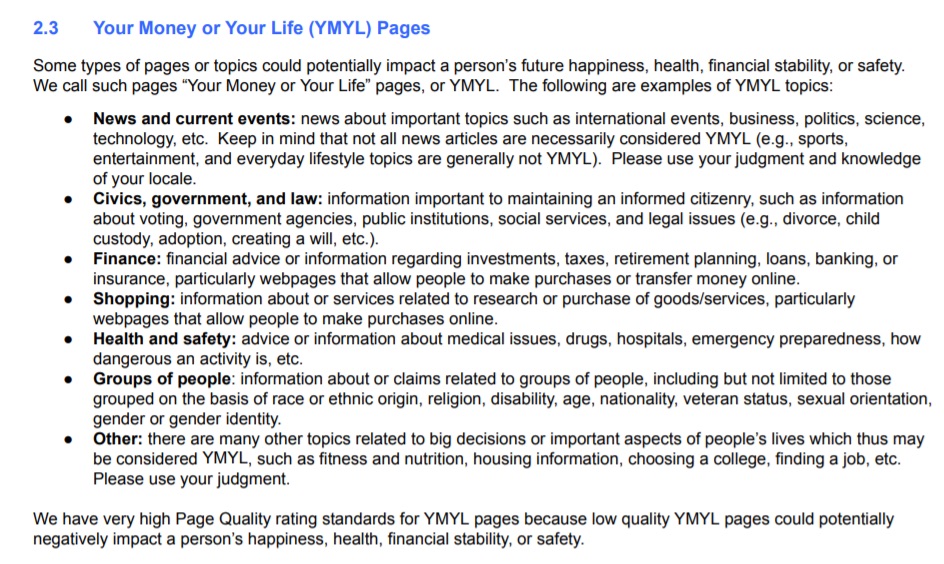
Google states that quality raters must use their judgment to determine whether a page qualifies as “YMYL” content: that is why these pages must show the highest levels of EAT.
Content, page and site quality
Another key factor in the evaluation of content by Google is the User Experience: pages that present ease of use of the site, attractive design and intuitive navigation will have greater credibility.
User Experience and SEO are two compartments linked together not only by the objective of positioning, but also by the intent to offer users a better overall experience.
Google ranking factors
Google, or even better its algorithm, takes into account a huge amount of factors (more than 200!) for the evaluation of the positioning of a page and its optimization.
Here are the main criteria to meet in order to positively impress evaluators and position your content as high as possible.
On-Page optimization for search engines
Aspects on which you have direct control and are therefore easier to correct.
Technical optimization of search engines
- Speed – Nobody enjoys waiting for too long, that’s why Google tends to send its users to pages that load quickly. So make sure that all your contents upload fast.
- Mobile-friendliness – Your content must be nice to look at and provide a good user experience especially on mobile devices (now Google’s index is mobile-first!).
- Code quality – Trying to keep a clean and clear code makes Google understand your content in an efficient and effective way.
- Security – The credibility of a site depends on its security (i.e. safe navigation and the presence of the HTTPS protocol).
Content Optimization for SEO
- Titles – The meta title and the header of the page are fundamental signs for Google: it is important for them to be neither too short nor too long, to contain the keywords and to be consistent with the content of the text.
- Content – Credible content, that serves a real purpose, and brings real benefits to the user is what Google searches for the most (be sure to create content that responds to users’ search intentions).
- Accurate content – Enriching content with images, sound and video gives the user a perfect user experience.
- Internal links – Google relies on internal links to identify which content on your site is most important and to find all the pages on your site (try to create a thick web between the content on your site, making it easier for the user to surf the net).
- Freshness – Updating content regularly makes Google understand that you are providing accurate information.
- Outbound links – These are important to confirm the credibility of the author and the website as well as to help Google analyze the relationship between different contents.
Off-Page Optimization for Search Engines
Off-Page SEO factors are the signals sent to Google from third-party websites: this category mainly includes links or mentions of your pages on other websites or social profiles.
Incoming links is the main Off-Page factor: links to your content from relevant and authoritative sites are a very strong signal for Google, which perceives the content as popular and worthy.
That’s why building a reliable inbound link profile is one of the pillars of search engine optimization. And for the same reason, you should pay attention to the Link Authority of the sites from which you get links, the relevance of the content surrounding the link itself and the relevance of the anchor text (the text people click on to visit the link).
Social media and trust signals
Sharing on social platforms and the general “noise” around your content is a signal to Google that your content is useful and appreciated. And when you recommend content as a solution to the user, it ends up at the top of the priority list.
All this is part of the signals of trust that indicate to Google that your brand, your products and your content are appreciated by users, and therefore credible. So: any positive activity around your products, your brand or your content is not only welcome, but recommended to improve its credibility.
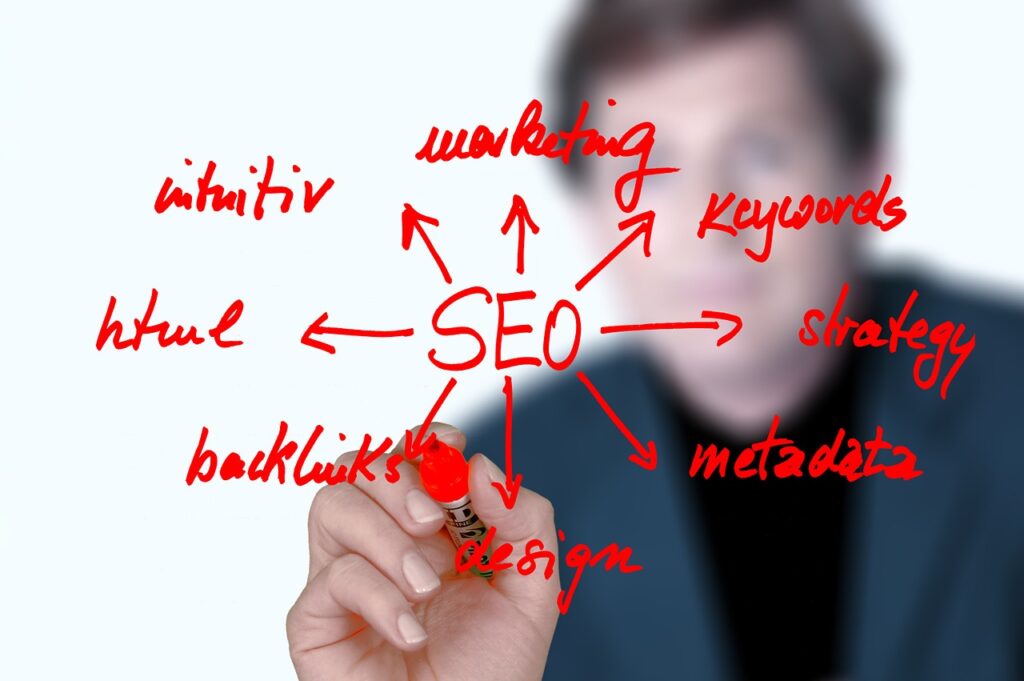
SEO: HOW DOES IT WORK?
At this point, let’s take a look at what can be done to improve the chances of being presented by Google as the most appropriate, relevant and useful answer to the question a user has asked.
The three main SEO categories taken into account are 1) technical, 2) content and 3) backlinks.
1) Technical
Crawlability – Google must be able to access your pages, read and understand your content.
Indexability – After Google has seen your page, it must be sure that you want to show it to its users: the noindex tag in the main section of your pages, for example, allows you to suggest to Google whether or not you want a specific page to be considered in search results.
Site structure – Your site should be structured in a way that makes it easy to understand the different sections and categories, as well as making it easy for Google to navigate every single page.
Markup scheme – This factor explains your content to Google in a way that the search engine understands, making it easy to read and understand. Take a look at Google’s tool to test the Schema.org markup on your pages (https://search.google.com/structured-data/testing-tool/u/0/).
Speed – We’ve already talked about this: users don’t like to wait, so each page must load up fast to gain credibility. Here is Google tool to test the speed of your pages (https://developers.google.com/speed/pagespeed/insights/).
Mobile-friendliness – We have already mentioned this aspect too: every page of your site must be mobile-friendly. Here you’ll find Google tool to test the user-friendliness of your pages on a mobile device (https://search.google.com/test/mobile-friendly).
2) Contents
Meta Titles and Meta Descriptions – These areas of a page determine, in many cases, what Google shows its users in search results.
An accurate meta title, which clearly and unequivocally describes what the content of the page offers to the user, is extremely important to increase your credibility.
Heading – The title that the user sees when it lands on your page is also crucial to Google and must be clear, unambiguous and include the terms the user searched for.
Writing style – Strive to use simple, clear, focused and consistent writing, perhaps with short sentences and always remaining “on topic”.
Detailed content – When including audio, video and images, match them with the appropriate meta tags to help Google understand what they are about.
Outbound links – As we have already said, these links refer to sources that confirm the accuracy of the content and validate the credibility of the site and the author.
Authors – If the author of a certain content has a very good EAT, this will bring further credibility: identifying the author explicitly is therefore a good practice to improve SEO.
3) Backlinks, Link Building and Guest Blogging
Backlinks (incoming links) are incredibly important in search engine optimization.
Internal links indicate the importance of content in the context of your site, but they do not help Google understand its importance in the global context.
Backlinks from relevant and authoritative sites, on the contrary, signal to Google that your content is popular, reliable and authoritative.
In 2012, Google released a significant algorithm update called Penguin, which aimed to eliminate the “cheating link”.
Moreover, in 2017 Google announced that any link to the pages of a site considered to be of low quality (with “spam” links) will be ignored and will not help to rank in user searches (source: https://moz.com/learn/seo/google-penguin).
A good Link Building strategy is therefore useful to identify people who have the ability to link to your content and encourage them to link to it from a relevant page on their site.
This implies, in most cases, a lot of time: contacting people, building relationships and convincing them that linking to your content is beneficial to them and their audience takes a lot of time.
Plus, for all this to work, your content must surely be of great quality and bring value to the users (a feature that everyone, not only Google, looks for).
Finally, writing articles for other relevant and authoritative websites (i.e., Guest Blogging), not only can help you build an author’s or site’s reputation, but it also allows you to create incoming links from a reliable and authoritative source, and this is definitely one of the best opportunities to create an effective backlink.
SEO and Social Media
It is not entirely clear (or at least official) whether social media activity is of direct help for SEO positioning.
However, Google itself has several times suggested that a healthy social media presence, edited with constant commitment and accredited by a relevant audience, helps SEO in a positive sense (source: https://neilpatel.com/blog/social-media-and-seo/).
Finally, but you already know this, a good social media activity helps enormously to build reputation, brand awareness and a loyal community.
SEO: what’s the timeline?
You’re probably wondering: “Okay, but how long does it take to get my results to the top position?”
We would love to tell you “Just one click!”, but let’s be honest: search engine optimization is a long-term strategy.
Of course, there are actions that can be taken immediately (such as internal corrections, changes to titles or descriptions), but the real results will certainly not be seen overnight.
Numerous and constant efforts, such as creating a substantial volume of informative content, creating links or attracting positive reviews, and implementing the Schema.org markup on a number of pages, take time and patience.
Every little change is an integral part of the SEO macro strategy and every single action must be done in the best possible way to see the results.
And the visible results are what Exa Futures aimes for. We are a Digital Agency strongly oriented towards measurable achievements and objective results: let our team of experts support you in the SEO strategy for your company or business. We will be glad to work with you and achieve positive and visible results together.