
Giving the right content to the right user through a coherent user-experience: this is basically the true strength of native advertising, as well as the outstanding idea on which it is grounded.
In fact, native adversting differs from Display advertising (also known as “advertising banners”), as it does not look like the ads we usually see – sometimes even unwillingly – online. On the contrary, this kind of advertising fits the format of the website’s content visited by the user and relates, more often than other ads, to the content the user is perusing in that moment.
As a consequence, unlike other types of digital advertising, native advertising can perfectly fit the context in which it is used, being coherent with the website look and the organic content of the page.
Even though we already unveiled the basic core of native advertising, let us proceed in order.
I this article you are going to find out:
- What native advertising is
- Which advertising is native and how it works
- Native advertising’s regulation
- Numbers and predictions for native advertising’s global market
- Facts and figures on native advertising

What is native advertising?
Native advertising has basically one goal: creating ads that are so coherent and cohesive with the content the user is browsing (even as far as the web design of the hosting page or site is concerned), that they cannot be discerned as “foreign objects”. On the contrary, they are perceived as one with the content the user is reading, watching or listening to.
Thus, this kind of advertising tends to be more engaging and, sometimes, even more effective than Dispaly advertising: the non-intrusive look and the primary importance of user-experience are the key factors to the success of such advertising.
In doing so, native advertising aims for the creation of a continuous stream of content fruition, in a flawless process of optimization of the user-experience.
Unlike traditional advertising, such as banners on websites for example, native advertising is organically integrated in the user’s browsing session. Shortly, instead of showing another advertising banner, native advertising shows “advertisements which are less like other advertisements” and much more like the content of the web page they’re integrated in.
Which advertising is native?
The main idea of native advertising is to put the ads in a “native” context. This means that it is most likely for a native advertisement to look like other articles and content surrounding it, than for it to be invasive, avoiding the typical advertising’s captions inviting the user to a call to action (purchase, subscription, registration, etc.).
Data from a research led by Sharethrough (source: https://www.sharethrough.com/resources/in-feed-ads-vs-banner-ads/) show accurately how more powerful and effective native advertising is, when compared to Display ad:
- native ads are willing to be seen 53% more than other advertisements;
- native ads registered an increase of 18% in the intention of purchase and of 9% in the response to brand affinity;
- 32% of interviewees claimed that a native ad is “one I could share with a friend or relative”, versus only 19% of display advertisements.
Native advertising shows to be effective both on the side of demand and the one of supply. Publishers, with their own specific audience, are the players involved in the offer, trying to make money out of their sites. On the other hand, demand’s players are advertisers, trying to hit their potential audience and to achieve their goals (such as awareness, branding or lead generation).

Native advertising’s regulation
How many times has it occurred that, by clicking on an interesting article, you have found yourself on a website that you’ve never heard of or that does not seem reliable at all?
In order to avoid consumers (and that means all of us), from being baited by misleading ads, FTC (Federal Trade Commission) and IAB (Interactive Advertising Bureau) are striving to regulate native advertising’s use.
To apply standards to this market, which is growing fast, IAB (an association defining advertising’s standards) decreed 6 native formats:
- In-Feed: paid ads included in a publishing website’s content listing;
- Paid Search: paid ads included in the results of a search engine;
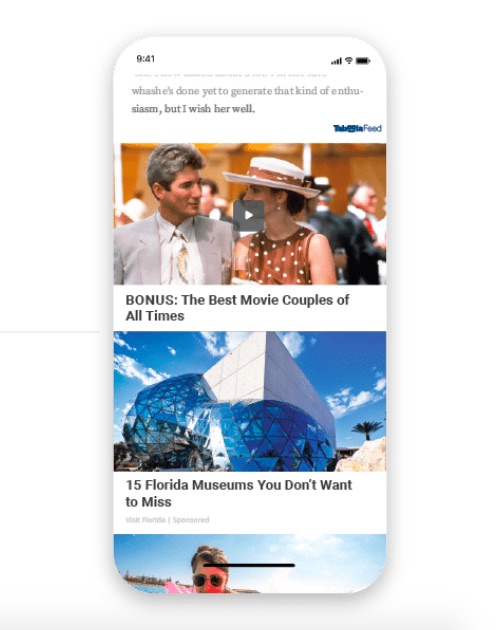
- Recommendation widget: paid ads promoting content related to a specific article;
- Promoted listings: paid ads included in an e-commerce product listing or classified;
- In-Ad: content included in a standard advertising format (for example, 300×250 pixel);
- Custom: special tailor-made ventures led independently by a brand or in partnership with a publisher (for example, sponsored articles).
Here is the official document by IAB: https://www.iab.com/wp-content/uploads/2015/06/IAB-Native-Advertising-Playbook2.pdf
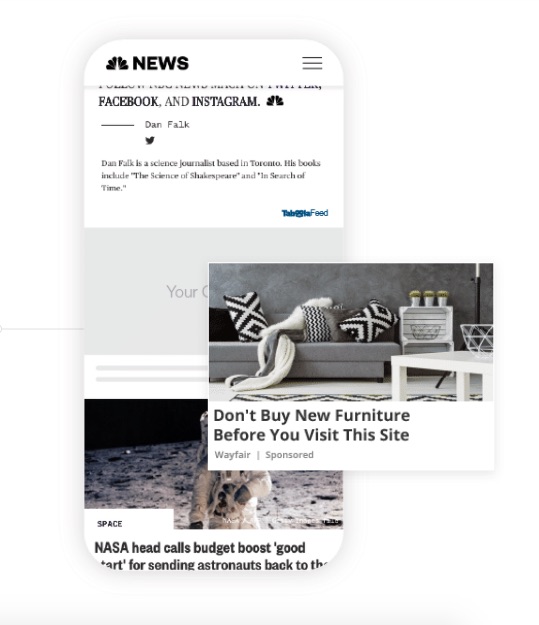
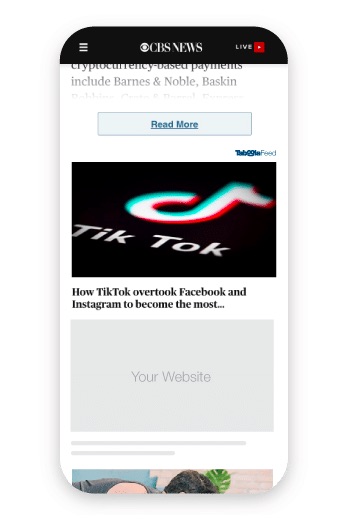
Here are some examples of native advertising from two of the world’s leading players, Taboola and Outbrain.

https://www.taboola.com/ https://www.taboola.com/ https://www.taboola.com/ https://www.outbrain.com/ https://www.outbrain.com/ https://www.outbrain.com/



Native advertising in figures: the numbers of the global market
The analysis of the global spending on digital advertising shows that the spending on native advertising should see an increase of 37% from 2020 to 2025 (source: https://www.prnewswire.com/news-releases/global-native-advertising-market-set-to-be-worth-over-400bn-by-2025-300805997.html)
This means an increase for the native advertising’s market from 85,83 billion dollars in 2020 to a grand total of 402 billion by 2025.
United States will still be the largest market for native advertising, going from a spending of 29,56 billion dollars to 139,5 billion by 2025.
Western Europe‘s market is also expected to increase up to 92,37 billion dollars by 2025, with UK, Germany and France on top.
UK’s market will be the largest in Europe and, according to forecasts, is going to increase from 5,81 billion dollars in 2020 to 27,42 billion by 2025.
Meanwhile, Germany will go from 4,43 billion dollars to 20,90 billion by 2025, while France will go from 2,03 billion dollars in 2020 to an expected grand total of 9,58 billion by 2025.
According to eMarketer, by the end of 2020 two thirds of all programmatic advertising (i.e. advertising bought not through standard auction system, but through the use of automated technology – which combines data and optimization algorithms to show the advertisement to the fitting user) will be designed for mobile devices rather than desktop use. Besides, 83,6% of all digital video ads in the United States will be distributed through automated systems.
Figures, facts and case studies
- The New York Times, through the use of native advertising, quadrupled the number of visible impressions of its ads in comparison with similar standard banners (source: https://www.thinkwithgoogle.com/intl/it-it/strategie/app-e-mobile/creare-esperienze-pubblicitarie-migliori-tutti/)
- The company Holiday Extras saw a dicrease of 25% in the acquisition cost (source: https://www.thinkwithgoogle.com/intl/it-it/strategie/dati-e-misurazione/holiday-extras-una-crescita-incrementale-grazie-alle-campagne-display-smart/)
- Audible‘s convertions increased by 114% thanks to the acivation of smart display campaigns (source: https://www.thinkwithgoogle.com/intl/it-it/canali-pubblicitari/rete-di-ricerca/le-tattiche-intelligenti-per-la-pubblicita-display-di-audible-fanno-aumentare-le-conversioni-del-114/)
- iWYZE‘s conversion rate increased by 562% thanks to the automated creation of illustrated, native and textual ads, which could fit anywhere in Google’s Display Net (source: https://www.thinkwithgoogle.com/intl/it-it/risorse-di-marketing/dati-e-strumenti-di-misurazione/grazie-alle-campagne-display-smart-iwyze-aumenta-il-tasso-di-conversione-del-562/)

Should I give it all up and go for native advertising?
Native advertising is not an absolute truth or something to be endorsed above everything else. Though, at the same time, it is not to be ignored.
In the broad and complex universe of digital advertising, it still proves to be a tool worth considering and, as such, its use needs to be taken into account while designing your high-level strategy especially in relation to your goals, always keeping in mind the first requirement: every context, i.e. every market, is different.
If you are looking for support while designing your digital advertising strategy, or you are not sure whether activating a native advertising campaign, please contact us: we will be glad to answer your questions and lead you into the amazing world of digital communication.