


As for any topic you are not aware of, everything always starts with the question “What is it?”. And so, what is MarTech?
In this article you will learn exactly what is meant by MarTech, you will discover why it is so important and maybe you will realize that you are already using it.
In its simplest definition, MarTech is the term that represents the convergence of Marketing and Technology. But maybe you already knew that.
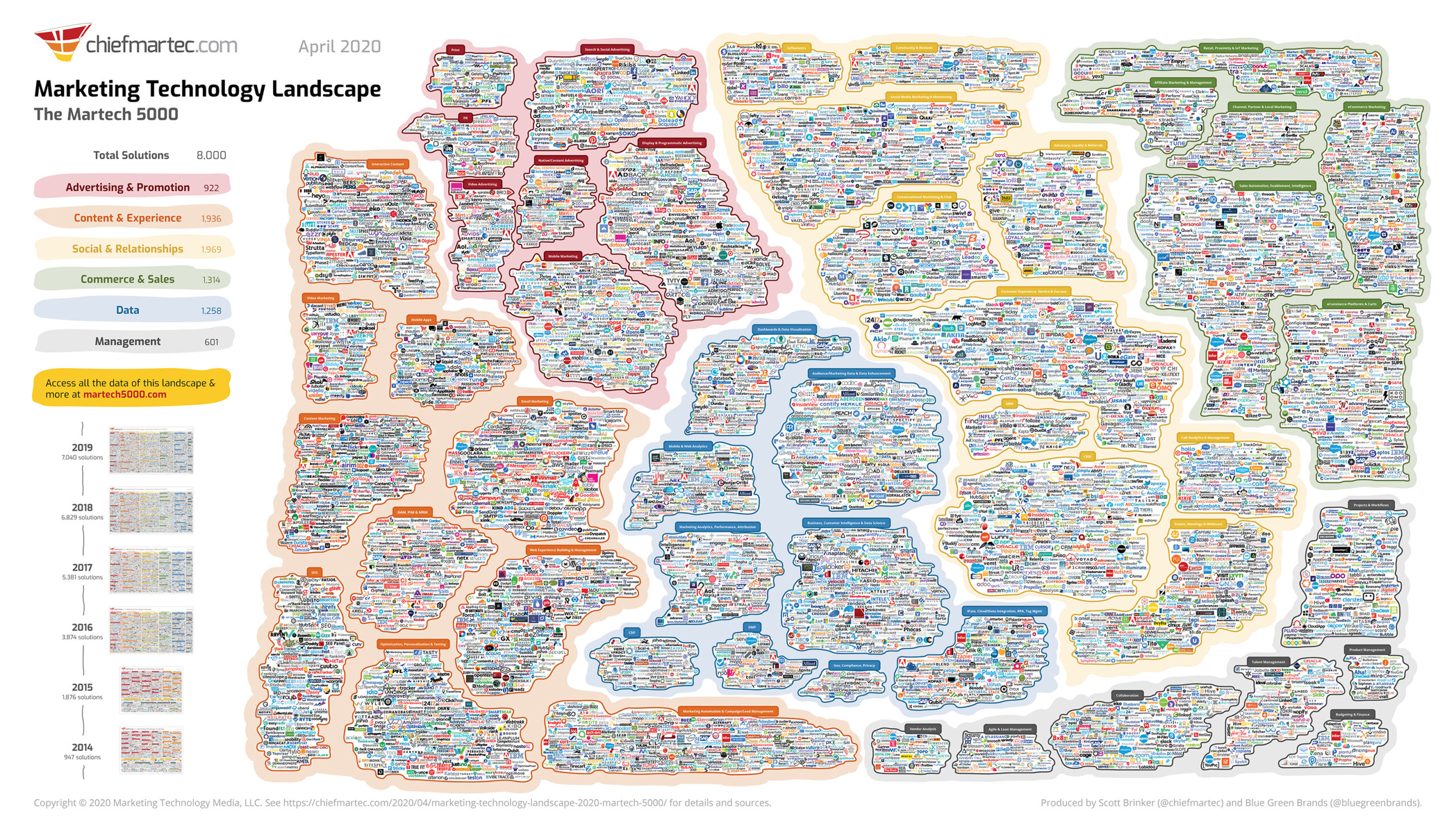
And maybe this term doesn’t sound completely new to you because you associate it with an image, the Marketing Technology Landscape Supergraphic, produced every year by Scott Brinker (https://chiefmartec.com/2020/04/marketing-technology-landscape-2020-martech-5000/).
It’s a huge graphic that illustrates the ever-growing number of platforms and technology tools available to marketing experts around the world, from SEO, email, chat bots, CRM, eCommerce and much more in exhaustive details.
According to Scott Brinker (https://twitter.com/chiefmartec), the term “MarTech” applies to major initiatives, efforts and tools that leverage technology to achieve marketing goals. But, he adds, there is “much more to MarTech than just technology and software”. Nowadays, in fact, the term increasingly encompasses the profession and experience that these hybrid experts can boast.
Among these hybrid professionals there are also us at Exa Futures, which since 2016 we have been studying how to make life easier for Marketing and Communication teams through the correct use of technology and data. (https://exafutures.com/en/martech)
As Digital Marketing has grown, so has the MarTech landscape, as technology is developed to help better connect the dots between each digital solution.
By integrating platforms and data at all stages of the customer’s journey, MarTech allows companies to
1) Create smarter strategies based on what works,
2) Help to simplify the processes,
3) Identify ways to make marketing communications as personalized as possible and therefore more effective.
Today, MarTech has become literally essential if you want to remain efficient, profitable and competitive. And just as software is designed to make your life easier, that’s what MarTech is all about.
Today it is no longer possible to market effectively without a solid technology stack: choosing the right tools for your company is therefore an integral part of your success.
Of fundamental importance, moreover, is the understanding of the areas in which to invest: not all companies need a solution for every single category, in the vast panorama of Marketing. That’s why it’s important to identify the tools you need for your business and focus on using those without being overwhelmed by all the other options available (and they are many!).
MarTech, finally, is increasingly moving towards the vision of a unique user-experience that is like a continuous journey, accompanying the user/customer from marketing to sales, up to the provision of products or services.

What is MarTech?
The 6 main categories of MarTech tools
Advertising and promotion
The platforms and advertising tools are a crucial element of the MarTech stack.
They are used to simplify paid advertising efforts in search engine marketing (SEM) campaigns, as well as in social media and programmatic advertising.
Here are some examples.
- Business Manager: the fundamental tool for advertising on Facebook and Instagram. Whether you are an agency or a professional, you can’t ignore this tool.
- Google Ads: the software that allows you to insert advertising space within Google search pages. Considering that Google contains about 87% of global searches, it is another fundamental tool.
- SEMrush: one of the most reliable and used suite in the world, contains within it tools and utilities to be used in different areas, from Keywords Research to SEO tools, from the study of competitors to comparisons between research volume, CPC and competitiveness.
- SEOZoom: an all-Italian Web Marketing Suite, to analyze traffic volumes, keyword trends and many other features.
Content Marketing
There is a range of key MarTech tools in this category, including content management systems (CMS), search engine optimization tools (SEO), landing page tools and marketing automation and lead management platforms.
Here are some examples.
- WordPress: by far the most widely used Content Management System (CMS) in the world, allows you to manage content and create websites with ease and numerous customization possibilities.
- Shopify: used purely for e-commerce sites, thanks to its intuitive interface and, also in this case, to the numerous customization possibilities offered by the software.
- Mailchimp, MailUp, ActiveCampaign, SendGrid: would you like to send your contacts a monthly or weekly newsletter or a specific communication about a particular event? One of these software makes your life easier.
Social media marketing
Social media marketing connects your audience and promotes your brand on social media channels. MarTech tools are essential for campaign management and planning, monitoring social media conversations and the power of influencer marketing.
Here are some examples.
- Business Manager: also for Social Media Marketing activities, from the management of advertising campaigns to the monitoring of all results, the Facebook business platform is an excellent ally for professionals and companies.
- Upfluence: it is a large scale influencer platform with many features. The most important part is certainly related to its search engine and influencers discovery.
- HypeAuditor: Do you want to know the ranking of certain influencers in certain areas or sectors? This is the tool for you.
Trade and Sales
Sales automation, customer service and customer relationship management (CRM) tools are all essential additions to the MarTech stack, allowing you to automate and manage various aspects of the sales and customer management process on a large scale.
Here are some examples.
- ReferralCandy: is without doubt one of the most important tool for a good e-commerce marketing. It is a referral generation platform, which allows you to create and communicate connections between products and services.
- Spently: used together with Shopify, it allows you to activate up-selling events, discounts and referral tools based on customer interactions, as well as retrieve “abandoned carts”.
- Tapcart: is a software that greatly facilitates the process of creating and customizing mobile apps for your online store.
Data and Analysis
Data and analysis tools enable organizations to access, integrate and analyze data from multiple sources to get a complete 360-degree view of the customer and the critical information needed to optimize campaigns. Important additions to the MarTech stack include customer data platforms and data analysis, visualization and web data analysis tools.
Here are some examples.
- Tableau Public: is a free software that can connect any data source and create data views, maps, dashboards and many other solutions.
- Microsoft Excel: one of the most popular and most used tools in many areas. A good data analysis can only start from an Excel spreadsheet.
- RAWGraphs: is an open source app created with the goal of making the visualization of complex data easy for everyone. RAWGraphs aims to provide a missing link between spreadsheets and vector graphics editors.
Management and collaboration
Management and collaboration tools are essential to help organizations become better organized and more productive. Communication tools and project management software are vital inclusions in the MarTech stack.
Here are some examples.
- Trello: one of the most popular project management tools, which allows the assignment and coordination of tasks, through the “cards”, in its boards.
- Slack: it is a software that simplifies communication within a company, as well as giving its users the possibility to always have access to applications, services and resources used daily.
- Zoho Projects: we at Exa Futures use just this tool. It is a Cloud-based project management tool that helps you plan and monitor your work, as well as collaborate with your team wherever you are.

What is MarTech? Some best practices
Here are some best practices to develop a winning MarTech strategy:
- Create a MarTech stack from top to bottom, i.e. starting from the company’s overall marketing strategy and goals, is the first point to develop a winning MarTech strategy.
By thinking in general terms of high-level objectives, you will reach better decisions on what specific skills and measurements you need to support. - Include all data: carefully consider all existing data sources that should be integrated to achieve your MarTech goals and make sure the selected solutions can work with those sources.
Having a complete customer profile, based on all available data, is critical. - Integrate with all channels: Carefully consider all the marketing and communication channels you need, as well as those you plan to use in the near future.
Only through effective coordination between all channels – email, SMS, on-site/in-app, online advertising, social media, call centers, etc. – will your MarTech stack allow you to optimize the overall customer experience. - Collaborate with IT: work closely with IT during the definition, selection and implementation phases. Although the goal of most MarTech solutions is to free marketers from IT dependency, IT participation and consensus are almost always necessary to build (and maintain) a productive MarTech stack.
- Measure and Optimize: continuously and professionally measure and optimize how your MarTech strategy works. Don’t be afraid to rethink decisions and make the necessary changes!
Now that we’ve given you some new ideas on MarTech, we hope we haven’t bored you and whet your curiosity to know more… our team will be very happy to answer all your questions!
Contact us today to learn more about how we can support the improvement of your technology stack and make your life easier with MarTech.