

Real Time Marketing (RTM) is a well-known topic among marketers. The capability to react quickly to external stimulations and interact with customers (or potential ones) across the entire supply chain, is a technique both theorized and supported by traditional marketing.
But the spread of Information Technology, the social media era, the greater possibilities in user profiling, along with a personalized marketing, have made RTM even more relevant and, most of all, have added more meanings to the term.
This article will go through the following topics:
- What is RTM
- When to use it
- Strategic examples
- The real benefits it can bring to our business
Real Time Marketing: an Umbrella Term
When it comes to RTM for social media, a distinction needs to be done. In fact, the term indicates two key aspects: on the one hand, the brand’s capability to interact with its community, intercepting its needs, requests and desires; on the other hand, the capability to ride the wave of the moment, that means creating thematic campaigns in order to exploit the media resonance created by an event (online or offline), a trend or a special occasion.
The first definition includes all the best practices that a social media manager has to carry out in order to create a profitable conversation with the community: moderating comments to posts, answering private messages, sharing user-generated content, reacting (in every sense) to users’ inputs.
The second definition is more ambiguous and still finds marketing professionals in disagreement. According to some of them, in fact, RTM techniques would also include the planning of content related to holidays and recurring occasions (such as Christmas or Black Friday, for instance), as well as planned events (such as the Oscars night, for example). Purists, on the contrary, believe the true RTM is to be improvised, that means involving only unpredictable events, and allowing the brand to ride the wave of the moment.
Obviously, all the actions included in the first definition are of primary importance: being active and interactive increases the followers’ engagement and, as we said, eases the going of conversations, providing the customer with one-to-one marketing.
The fifth edition of “State of Marketing” (Salesforce Research) states that 80% of potential purchasers believe an interactive experience with the brand to be as important as its products or services (source: https://www.salesforce.com/blog/marketing-statistics-to-know/).
The second definition, on the contrary, can be riskier.
Let’s see when its use can prove appropriate.

When is RTM a Good Idea?
If, on one side, taking advantage of the moment can prove favorable, as it allows to be included in ongoing conversations and to create likable content, on the other side the main risk is damaging the brand’s public image.
When (and if) we wish to implement our social media strategy with RTM, then, it is necessary to keep in mind the following:
- Listening to your community. It is fundamental to monitor the current trends and topics most interesting to your followers. In this respect, MarTech shows one again its importance when it comes to monitoring your community’s interests. For example, using tools such as TalkWalker (https://www.talkwalker.com/), a social monitoring platform which analyzes conversations in more than 190 countries and in over 187 languages.
- Staying in your field of action. Imagine if a law firm would celebrate the International Cat Day. Unless the content is extremely original, it would sound at least inappropriate. RTM can be a powerful tool, but it does not need to be used at any cost, especially if the theme is not suitable for your business or we do not know precisely how to use it to your advantage.
- Being creative. The key aspect of RTM: creativity. Being peculiar, brilliant and fun, creating unexpected content to benefit of the moment, can ensure visibility, if not virality.
- Being fair. RTM often generates a competition among “rivals”, as anyone tries to grab as much visibility as possible. Acting unfairly to your competitors can turn your brand image into a negative, ruthless one, with the risk of wiping out your efforts.
- Adding value. So, being relevant. Having a voice on a topic without adding further significance (be it irony or a call to action, for example) proves to be a barren action, if not even a failure.
- Not taking advantage of negative happenings. Ethics, especially when we deal with RTM, should always be taken into account. It may have occurred to come across some brands’ posts dealing with sensible topics such as racism, gender-based violence, natural disasters or crimes. In this case, exposure is not at all good exposure and it may even turn against us.
Strategic Examples
Now that we have seen when and how RTM is worth using, let us get through some examples.
Some brands, such as Ceres, Durex or Burger King have made RTM a great part of their social media strategy, being able to add value to their brands even through the most unexpected topics.
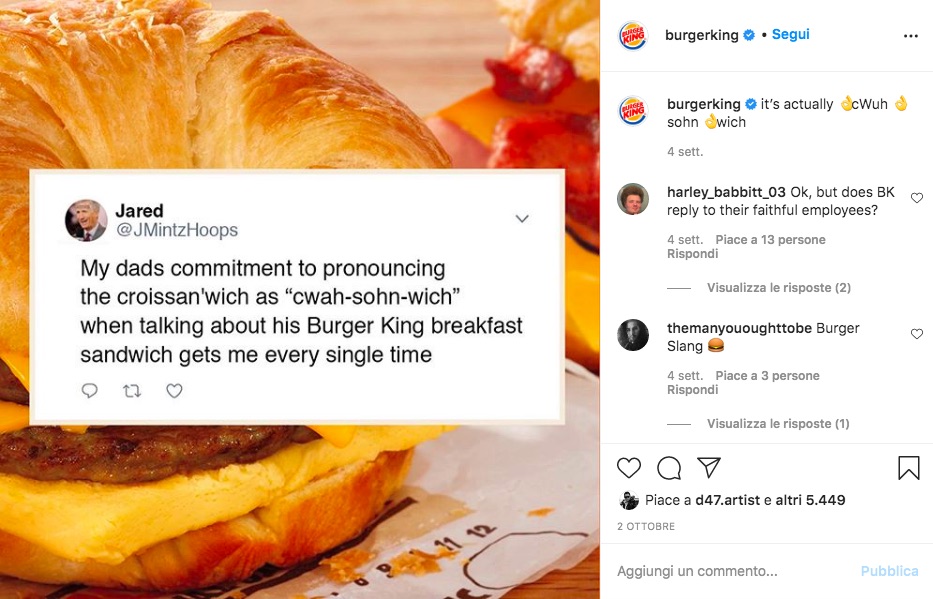
As you can see below, Burger King, for example, uses the ironic tweet of a follower to make fun of its own product (which is quite difficult to pronounce, actually!).
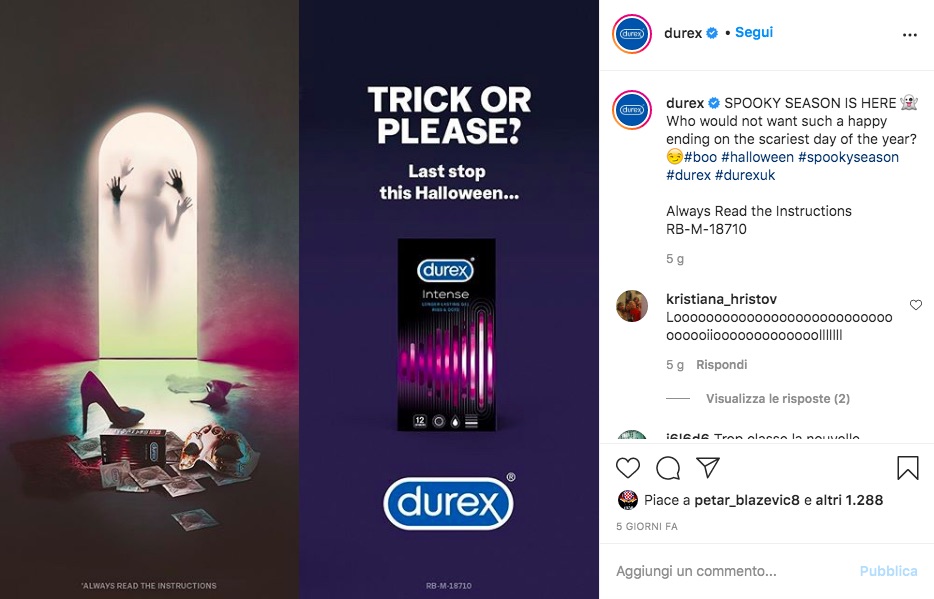
While Durex plays with the well-known Halloween “Trick or treat?”, referring to the assonance between “treat” and “please”. The caption is also related to the background image in which you can quite clearly spot a condom placed in a horror setting.
RTM can prove favorable even in adverse situations, if the timing is right.
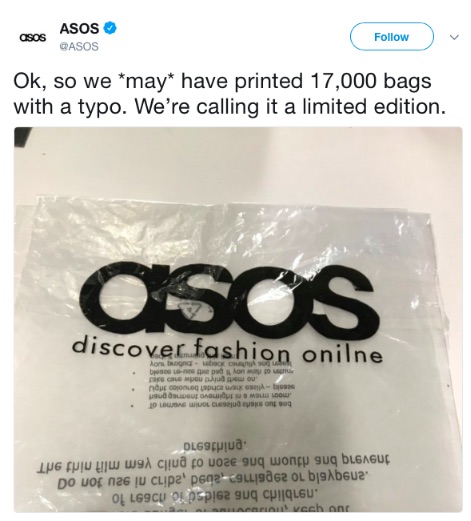
Just as it happened to ASOS: after having printed 17.000 bags with a misspelled word, ASOS promptly tweeted ironically about the fact, calling the bags “a limited edition”.
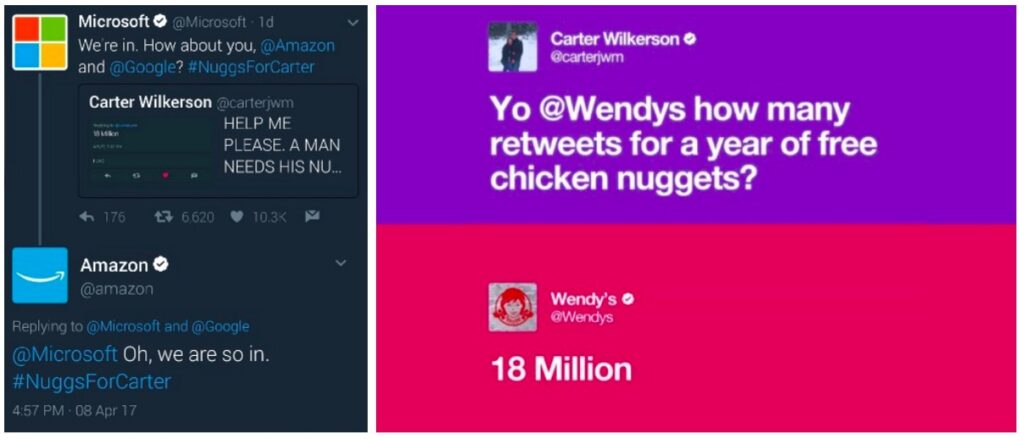
In some cases, content can go viral thanks to users’ inputs, if the brand shows responsiveness. As Wendy’s did when responding to the provocative tweet of a follower, which created great resonance around the brand, involving even big companies such as Microsoft and Amazon.
Another way to use RTM is connecting to offline events.
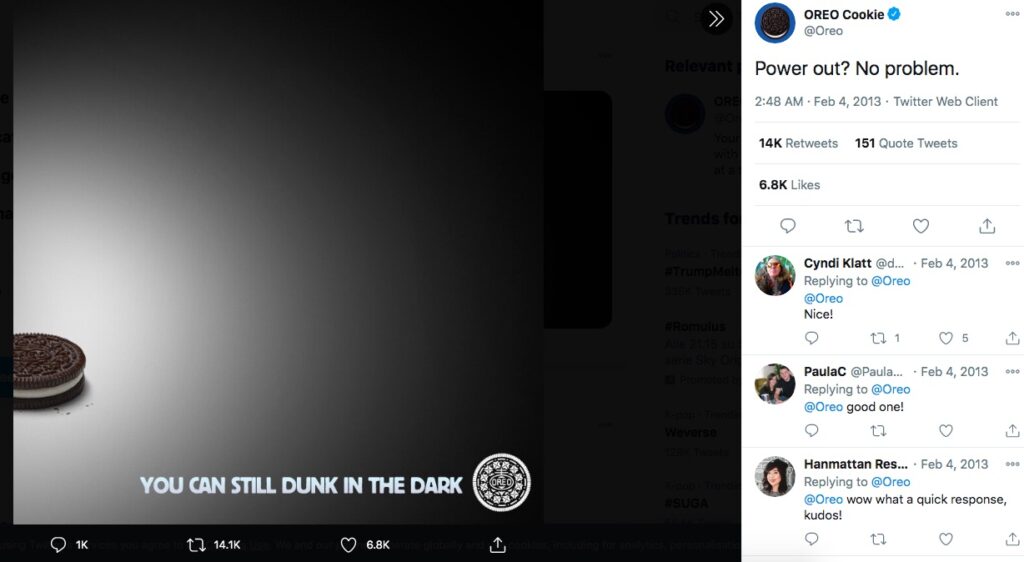
A textbook case is the Oreo‘s one: during 2013 Super Bowl finals, the stadium experienced a major power outage and fell into the dark. The brand saw the funny side of the things and tweeted the simple image of an Oreo biscuit on a black background, with the caption “You can still dunk in the dark” – with “dunk” meaning “to immerse” but also referring to a football offense technique. It goes without saying that it went viral. Slam Dunk, Oreo!
But, as we said, RTM can be a doubled-edge sword, when used in the wrong way. Being informed and always be listening are of crucial importance.
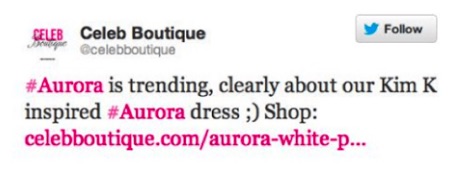
Something Celeb Boutique forgot, while tweeting the following. The brand rode the popularity of the hashtag #Aurora relating it to one of its dresses. Too bad, since the specific hashtag was trending at the time referring to Colorado’s mass shooting sadly known as Aurora Massacre.
Benefits for Your Business
According to a reasearch by Wayin, in 2015 59% of businesses already showed a preference for RTM and, among them, 66% declared the intention to implement the resources specifically allocated for social media (source: https://customerthink.com/how-real-time-marketing-drives-really-big-roi/).
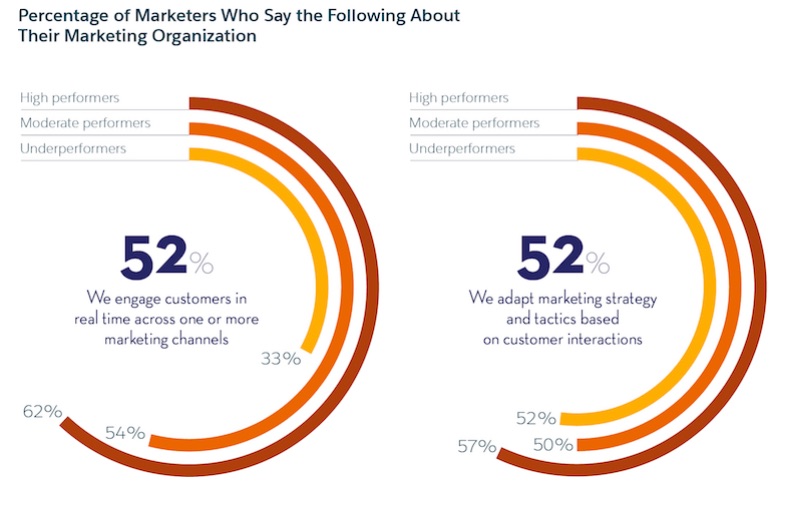
In 2019, 52% of businesses used RTM efficiently and effectively through more than one channel, and stated that, thanks to promptness, the chances of engaging the community increased 1,9-fold. Moreover, an equivalent 52% stated to have planned a marketing strategy based on conversations with users and their feedbacks (source: https://www.salesforce.com/blog/marketing-statistics-to-know/).
Besides, according to a research by Monetate and Ecoconsultancy, led mainly in the United Kingdom, using RTM increases the conversion rate up to 26%, while 45% of businesses declared to have taken advantage of such technique mostly on social media (source: https://oursocialtimes.com/real-time-marketing-increases-conversion-rates-by-26/#:~:text=84%25%20of%20companies%20see%20the,to%20customers%20in%20real%2Dtime.)
As we said at the beginning of this article, 80% of users believe an interactive experience with the brand to be as important as its products or services. It is clear then how increasing the engagement through prompt interactions as well as the creation of likable content, can play a key role in reinforcing brand loyalty and the probability of conversion, especially when such strategies come with the use of user profiling tools. Through A.I., in fact, they enable a deeper knowledge of our audience and their desires.
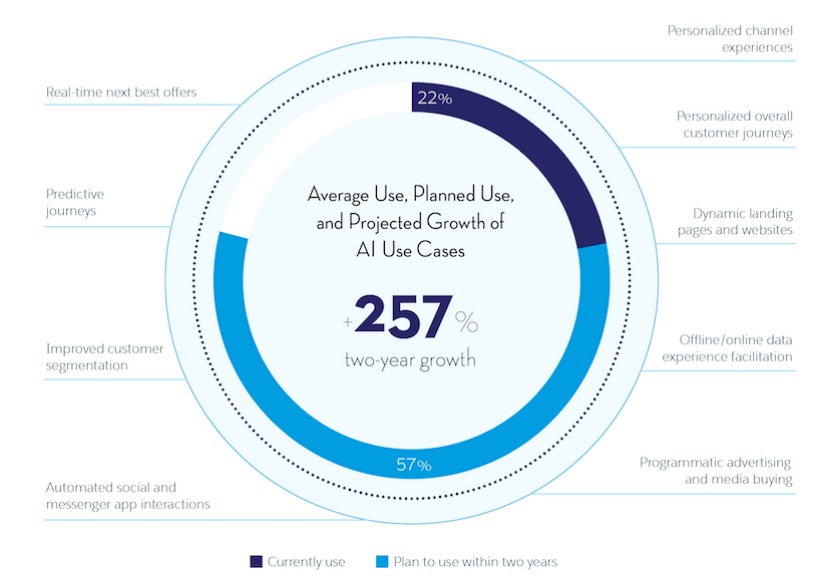
It is no coincidence that the use of A.I. for such purpose increased by 44% from 2017. And this percentage, according to marketers’ predictions, is expected to grow up to 257% in the next 2 years (source: https://www.salesforce.com/blog/marketing-statistics-to-know/).
Although, as we saw, RTM can prove to be quite risky as a strategy, the benefits it can bring to our business are still worth considering, especially in terms of engagement, brand awareness and conversion rate’s increase.
Listening to our audience, both when it comes to improvised content and direct interaction, proves to be an effective strategy, particularly when supported by MarTech tools. So, why not taking advantage of it?